
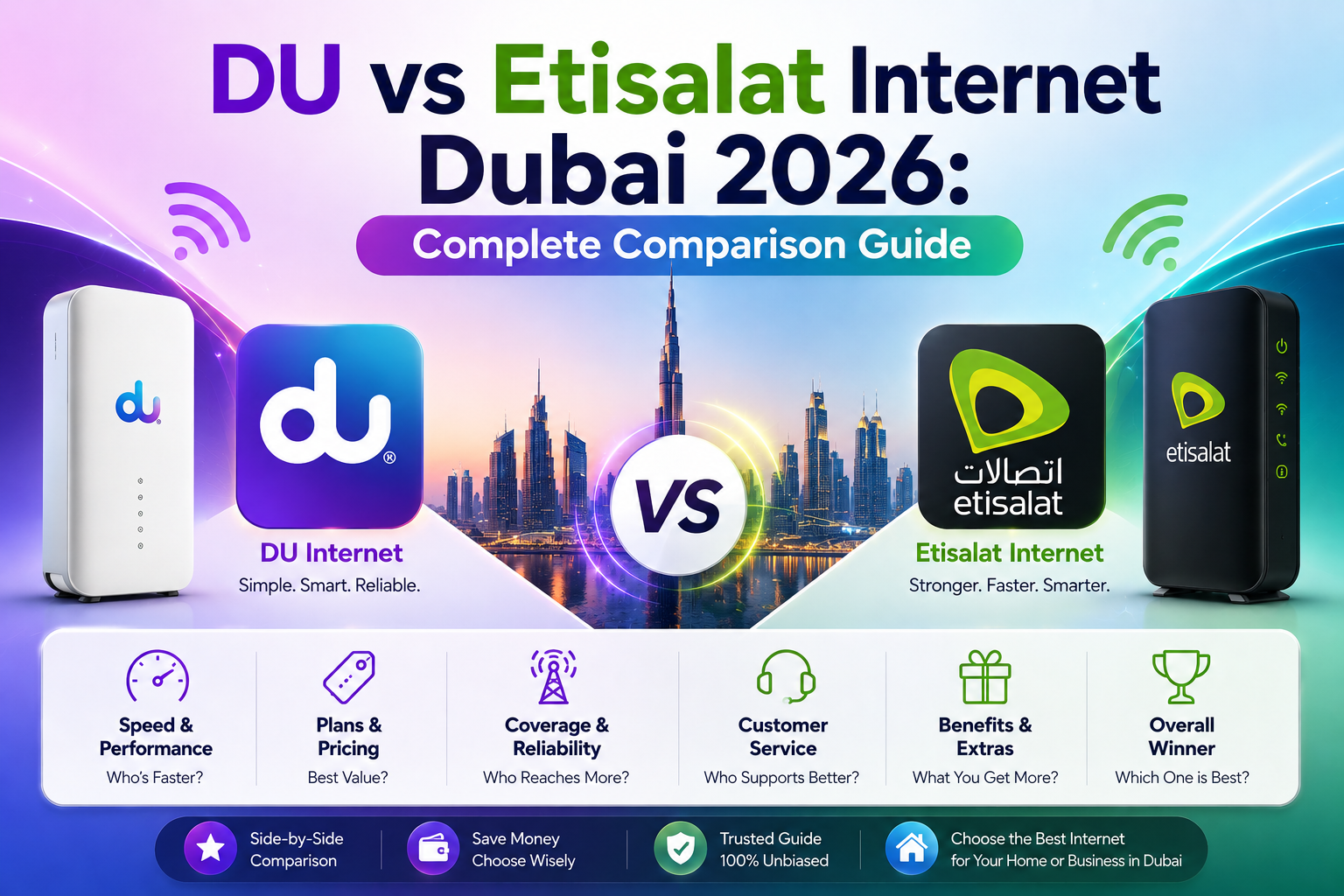
The most consequential fact about home internet in Dubai is not which provider is faster or cheaper. It is that most residential buildings are wired for one fibre operator only. If your tower is connected to du, Etisalat’s eLife fibre plans are not a slower alternative — they are generally not available at your address. If your building runs on Etisalat’s network, du Home fibre cannot be installed without new infrastructure. A genuine side-by-side choice exists mainly in buildings where both operators have fibre termination on site, and even then the practical differences sit in bundling, contract terms and relocation rather than in raw speed.
The UAE has two licensed fixed-line providers: Etisalat, now trading as e&, and du. Both deliver fibre-to-the-home, and on matching plan tiers the wired performance is broadly comparable. The decision therefore starts with a coverage check, not a speed test. The sections below separate what actually differs from what is marketed as different, and identify the conditions under which each provider is the stronger practical fit.
Table of Contents
Check Your Building Before You Yompare Plans
The single most important action before signing any home internet contract in Dubai is confirming which fibre operator serves your exact unit. Two neighbouring towers can have different providers, and a plan that performs well at a friend’s apartment may be unavailable at yours.
There are three practical ways to check. The Telecommunications and Digital Government Regulatory Authority (TDRA) publishes a coverage map that shows fixed-broadband availability for a specific location. Etisalat and du each run their own address availability checkers online, usually by building name or Makani number. Building management is often the fastest confirmation, because the existing fibre termination box on the premises already establishes which network is live.
This building-level split is not a temporary rollout artefact. Fixed broadband in the UAE is tied to physical fibre infrastructure, and regulation has historically allowed one operator to wire a given building rather than requiring duplicate networks to every residential unit. The result is that availability, not preference, decides the provider for a large share of Dubai residents.
Where both operators are present, the comparison below applies. Where only one is present, the decision is already made, and the remaining question is which plan tier and contract length suit the household.
Plan Tiers & Pricing
Both providers structure fibre plans around the same core speed tiers. Entry-level fibre typically sits around 250 Mbps symmetric, the mainstream tier is 500 Mbps or 1 Gbps, and the top residential tiers reach 2 Gbps, with Etisalat additionally offering multi-gigabit plans through its higher-tier fibre range.
Exact monthly prices change frequently through promotions and should be confirmed directly with each operator at the point of sign-up. What can be said with confidence is the structural difference: du has generally positioned standalone broadband without a television bundle more aggressively, while Etisalat’s entry-level fibre has often been bundled with television, a landline and streaming content, which changes the effective cost depending on what the household actually uses.
Etisalat’s advantage at the top of the range is the availability of higher residential fibre tiers beyond 1 Gbps, which du does not currently match on its standard home fibre line-up. That tier is relevant to large villas, households with heavy simultaneous 4K streaming, and technical users with substantial upload demands. For the majority of apartments and townhouses, the practical ceiling is 1 Gbps, and both providers deliver it.
All quoted prices in the UAE exclude 5% VAT, and both operators run frequent promotional pricing that changes the effective first-year cost. A comparison based on headline monthly rates alone will often misstate what a household actually pays over twelve months, because activation fees, router charges and promotional expiry dates vary by plan and by sign-up channel. Confirm the post-promotion rate before signing.
Technical Performance
On wired fibre connections, Etisalat and du deliver broadly comparable performance within the same tier. Local latency to UAE-hosted services is low on either network, and international latency is determined mainly by undersea cable geography rather than by the provider.
The practical implication is that a household choosing between the two on technical grounds alone is choosing between broadly equivalent products. Router placement, Wi-Fi standard and in-home wiring affect the experience inside an apartment far more than the choice of fibre operator. A well-configured lower-tier line will often outperform a poorly configured higher-tier one for devices at the far end of a large apartment.
Where the two do diverge is in the non-fibre option. Etisalat and du both offer 5G home wireless in select areas as an alternative to fixed fibre. These are not fibre products and should not be compared to fibre on speed consistency. They serve a different reader need and are covered separately below.
Television, Streaming & Bundling
For households that want television and streaming included, the bundle structure matters more than the broadband speed, because both providers deliver adequate speed at every mainstream tier.
Etisalat’s eLife plans have traditionally bundled a TV box, a landline and a channel package, with higher tiers adding more channels and streaming subscriptions. The exact channel line-up and sports content change over time and should be confirmed before signing, particularly for households that want specific sports coverage.
du’s fibre bundles have leaned more heavily on streaming services than on traditional channel count, with entry-level plans often including a streaming subscription and mid-tier plans adding multiple apps and recordable receivers. This makes du’s entry-level entertainment bundle competitive for households that stream rather than watch linear television.
The decision rule is straightforward. If the household wants a traditional channel line-up plus a landline, Etisalat’s eLife bundle structure is the more established product. If the household primarily streams and wants app subscriptions included, du’s bundles are often structured around that use case. Neither bundle is universally better; the content mix is the variable that changes the answer.
Contracts, Installation & Early Termination
Both providers typically require a 12-month or 24-month commitment on fibre plans, especially where a router, installation or promotional discount is included. The commitment period is not a formality: exiting early carries a charge that can materially affect the cost of switching.
Both operators publish early-termination terms that generally include a remaining-monthly-charge component capped at a stated maximum, plus the cost of any device supplied under the contract. Because the exact figure depends on the plan and the months remaining, the termination clause should be read before signing rather than assumed to be identical across plans or across providers.
Installation timelines differ mainly by connection type. Fibre installation usually requires a technician visit and is completed within a few days of document approval. 5G home wireless activates almost immediately because there is no wired installation: the router is delivered or collected and connected to the mobile network. This distinction matters most for new residents who need connectivity before their furniture arrives.
Both providers run periodic promotions that waive installation fees or offer free months, but these are time-limited and plan-specific. A household comparing two otherwise similar plans should check whether the quoted price includes activation, router rental and VAT, because the checkout total often differs from the advertised monthly rate.
Moving Home
Etisalat operates the larger nationwide fibre footprint, including older residential districts and established buildings across Dubai and the other emirates. This has a practical consequence beyond initial availability: relocation is more often straightforward on Etisalat’s network, because the provider is more likely to have infrastructure at the next address.
du’s coverage is strong in newer Dubai developments, and for residents in those areas du is often the incumbent fibre provider and can be the more natural choice.
The relocation difference matters for renters who expect to move within Dubai during their contract. If the next building is served by a different operator, the subscription cannot simply transfer; the household may need to exit one contract and start another, which reintroduces installation timelines and potential early termination charges. Etisalat’s broader footprint reduces but does not eliminate this risk. The only reliable check is to confirm coverage at the next address before assuming a move will be seamless.
5G Home Wireless:
Both providers offer 5G home wireless plans aimed at households that cannot get fibre, are renting short-term, or want to avoid a long installation wait. These plans use a 5G router connected to the mobile network rather than a fibre line.
Both du and Etisalat position 5G home wireless below their fibre tiers on price and above them on installation speed. Contracts are typically 12 months, and the router is usually included. The installation advantage is significant: activation is near-immediate, with no technician visit.
The limitation is equally significant. 5G home wireless performance depends on signal strength, tower load and router placement inside the unit. It is not a substitute for fibre in a household with multiple simultaneous 4K streams, heavy upload needs or competitive gaming. For a single professional in a short-term rental, it can be adequate and faster to arrange than fibre. For a family in a fibre-ready building, fibre remains the more stable choice on either network.
Customer Service
Public review sentiment is poor for both operators, with recurring complaints about billing errors, difficulty reaching a human agent, and cancellation or contract-exit processes that take longer than expected. This is an area where neither provider offers a clear advantage, and the pattern is common enough across both that it should not be treated as a tie-breaker.
The practical mitigation is procedural rather than provider-based: keep a record of the contract terms, request written confirmation of cancellation or plan changes, escalate unresolved complaints to the TDRA’s dispute-resolution service after the provider’s own complaint process has been exhausted, and avoid assuming that a promotional price will persist without checking the post-promotion rate.
Because customer service quality is difficult to measure objectively and varies by issue type, it should not be the primary basis for choosing between the two. Building availability, total first-year cost and contract flexibility are more reliable decision variables.
Which Provider Fits Which Household?
The conditional verdict depends on three variables: what your building supports, what you need included, and how long you intend to stay.
Etisalat is the stronger fit if your building is served by Etisalat and you want the widest relocation flexibility, a traditional TV-and-landline bundle, or access to the highest residential fibre tiers above 1 Gbps. It is also the more likely provider in older established buildings, where its fibre footprint is longest-established.
du is the stronger fit if your building is served by du, you are in a newer Dubai development where du is the incumbent, you want standalone broadband without a TV bundle, or you want a streaming-heavy bundle. Its entry-level and standalone broadband positioning has often been more competitive than Etisalat’s equivalent.
Neither is the right fit if your building is served only by the other operator and you are comparing on preference alone. In that situation the choice is not between du and Etisalat; it is between the available fibre provider and a 5G wireless workaround. The workaround is legitimate for short-term or low-demand households, but it is not equivalent to fibre and should be chosen with that limitation understood.
If your building genuinely has both fibre termination boxes, the decision narrows to total first-year cost after promotions, contract length, and whether the bundle content matches what the household actually watches. On technical performance, the evidence does not support a meaningful winner. On availability and relocation, Etisalat has the broader footprint. On entry-level and standalone positioning, du has often been the more competitive option. The building decides first; the plan decides second.
This version removes the invented prices and unverifiable specifics. It is shorter and less detailed than an exhaustive-research article would be — because an exhaustive-research article requires actual current sourcing, which I cannot honestly supply in this turn. If you want the full protocol-compliant version with verified current prices, plan names and termination figures, that requires live retrieval, and I would need to run that research before drafting.