
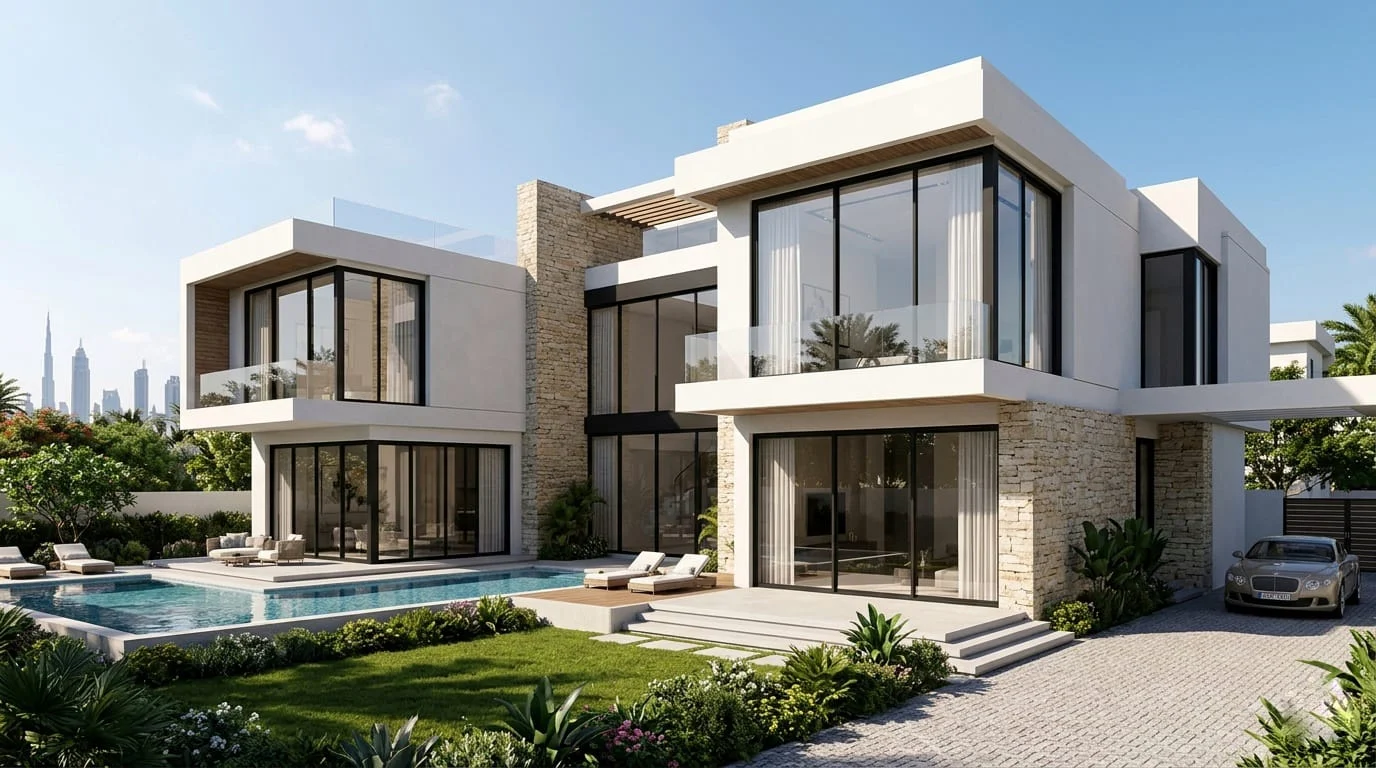
The phrase “aluminium glass” is shorthand for a window or door system where aluminium framing supports a glazing unit. In Dubai villa projects, that typically means aluminium-framed sliding doors, casement windows, fixed floor-to-ceiling glazing, and glass room enclosures. The aluminium provides structural support and the frame profile; the glass provides the view, daylight, and a large share of the thermal and acoustic performance. Treating the two as separate purchase decisions is one of the most common ways villa owners end up with a system that looks right but performs poorly.
Aluminium itself has properties that suit Dubai’s climate well. It doesn’t rot, warp, or swell like wood. It resists the intense UV exposure that degrades many materials. And it can be extruded into slim profiles that carry large glass panes without bulky sightlines—something Dubai architects consistently favour for contemporary villa designs.
The problem is thermal conductivity. Aluminium conducts heat roughly 500 to 1,000 times faster than polyamide or uPVC. In a Dubai summer, when exterior surfaces can reach 70–80°C in direct sun and interior temperatures sit at 22–24°C, a standard aluminium frame becomes a thermal bridge. Heat flows straight through the metal into the air-conditioned space.
Table of Contents
Why Thermal Breaks Are the Specification That Actually Matters
A thermal break is an insulating barrier—usually a polyamide (PA66) strip reinforced with glass fibre—inserted between the interior and exterior aluminium profiles. It physically interrupts the metal-to-metal path that heat would otherwise follow. Without it, the frame itself works against the glass’s insulation.
The numbers explain why this matters in Dubai. A standard aluminium frame without a thermal break can have a U-value of 5.0 to 7.0 W/m²K. A thermally broken frame drops that to roughly 1.3 to 2.0 W/m²K when paired with double glazing—a reduction of around 70%. Dubai’s Al Sa’fat green building system sets maximum U-values for glazing that non-thermally-broken systems cannot meet, and the Building Energy Code provisions tightened further in 2024.
Condensation is another practical consequence. In a cooled villa, the interior surface of a non-thermally-broken frame can drop below the dew point of the indoor air. Water runs down the frame and pools on sills. It is one of the most common snagging items on Dubai residential projects and is largely preventable with proper thermal break specification.
When you review a quote, ask specifically: Is the frame thermally broken, and what is the thermal break width? A 24mm polyamide break is a common baseline. Wider breaks (34mm or 45mm) deliver measurably better performance and are required for higher Al Sa’fat tiers . A suspiciously low quote for “aluminium windows” often means the thermal break isn’t there.
The Glass Specification Is Half the System
Aluminium framing alone won’t keep a Dubai villa comfortable. The glazing specification determines how much solar heat enters the building, and in Dubai that is the dominant cooling load factor.
Standard clear double glazing—two panes with an air gap—reduces heat transfer compared to single glazing, but its solar heat gain coefficient (SHGC) can still sit around 0.70. That means roughly 70% of the sun’s heat passes through. In practice, that’s not enough for large glazed areas facing direct sun.
Low-E coatings change the equation. A Low-Emissivity coating is a microscopic metallic layer applied to the glass that reflects infrared heat while allowing visible light through. A double-silver Low-E coating can bring SHGC down to around 0.25—reflecting roughly 75% of solar heat—without making the glass dark or mirror-like. That distinction matters in Dubai because Al Sa’fat sets both a maximum shading coefficient and a minimum light transmittance. A heavily tinted glass can hit the solar target and fail the daylight requirement. The regulation effectively pushes specifications toward spectrally selective Low-E coatings rather than dark tints .
Argon gas fill between the panes adds another layer of insulation. A 6mm/12mm/6mm double-glazed unit with argon and a Low-E coating is a common high-performance configuration for UAE villas.
The practical point: when a supplier quotes “double glazing,” ask what coating is on the glass and what the SHGC or shading coefficient is. Without that number, you don’t know what you’re buying.
Dubai-Specific Conditions That Change the Decision
Coastal Villas Face a Different Corrosion Risk
Salt-laden air accelerates the breakdown of lower-grade aluminium finishes. Villas near the coast—Palm Jumeirah, Dubai Marina, Jumeirah—need marine-grade powder coating or anodising to resist oxidation and coating deterioration. Without it, the finish can start to become uneven within five or six years, and hardware corrosion follows. Standard architectural-grade aluminium may be sufficient inland. On the coast, the coating quality is not a cosmetic choice.
Dust and Sand Demand Better Sealing
Dubai’s dust and sandstorms put pressure on the seals and gaskets of any window system. The frame profile and the installation quality determine whether dust migrates into the home. A multi-layer sealing structure and proper gasket compression matter more than the frame material itself. Slim-frame systems, while aesthetically desirable, leave less tolerance for sloppy installation—a poorly fitted slim frame shows air and dust leaks faster than a bulkier system would .
The Cooling Load Is Non-Negotiable
Air conditioning accounts for 60–70% of residential electricity consumption in Dubai during summer . Every watt of heat that enters through the window assembly translates directly into cooling load. If a villa has large glazed openings facing west or southwest, the glazing and frame specification is one of the highest-leverage energy decisions in the building.
Where Aluminium Works Well—and Where It Doesn’t
Aluminium framing is a strong choice for villa sliding doors, large fixed panels, and floor-to-ceiling glazing where structural strength and slim sightlines matter. It handles Dubai’s heat without warping and doesn’t require the repainting that wood does.
It is not automatically the best choice for every opening. For smaller windows in bedrooms where insulation and noise reduction are the priority, high-quality uPVC with steel reinforcement can outperform standard aluminium on thermal performance and often costs less upfront. The trade-off is bulkier frames and less design flexibility. For villas that are not on the coast and where sightlines aren’t the primary concern, uPVC is a legitimate alternative worth pricing.
The decision isn’t “aluminium versus uPVC” in the abstract. It’s which system, at which specification, for which opening, at what installed cost. A villa with large west-facing sliding doors and small north-facing bedroom windows may warrant different specifications for each.
Practical Checks Before You Approve a Quote
- Confirm the frame is thermally broken. Ask for the thermal break material (PA66 GF25 is the standard) and the break width in millimetres. If the supplier can’t answer, the system likely doesn’t have one.
- Ask for the Uw value—not just the glass U-value. Uw is the whole-window thermal transmittance, including the frame. A good glass specification can be undermined by a poor frame.
- Request the SHGC or shading coefficient of the glazing. In Dubai, solar heat gain is the primary cooling load driver. A “Low-E” label without a number is marketing, not specification.
- Check the air permeability and water tightness classification. Class 4 air permeability is the benchmark for UAE conditions; Class 5A or higher water tightness is appropriate for exposed locations.
- If you’re near the coast, verify the coating specification. Marine-grade powder coating or anodising is the difference between a frame that lasts and one that oxidises within a decade.
- Ask who installs the system and how they seal it. Installation quality determines whether the performance you paid for is delivered. The best frame and glass in the wrong hands will leak air, dust, and water.
Frequently Asked Questions
Is aluminium better than uPVC for a Dubai villa?
Neither is universally better. Aluminium offers strength, slim sightlines, and large-panel capability. uPVC typically performs better on thermal insulation and costs less for standard-sized openings. The right choice depends on the opening size, location (coastal vs inland), and whether you’re prioritising design flexibility or thermal performance.
Do I need thermally broken aluminium in Dubai?
For any new build or significant renovation that requires a Dubai Municipality permit, effectively yes. Al Sa’fat performance thresholds are difficult to meet without thermally broken frames. Even where not strictly mandatory, the condensation risk and cooling cost penalty of non-thermally-broken aluminium in Dubai’s climate make it a poor long-term choice.
How much do thermally broken aluminium windows cost in Dubai?
Costs vary significantly by system, glazing specification, and installer. As a rough market indicator, thermally broken double-glazed systems in Dubai have been quoted in the range of AED 200–350 per square foot for supply and installation, compared with AED 120–250 for standard systems. Treat these as broad indicators, not fixed prices—the spread reflects the wide variation in specification and quality.
Will aluminium windows corrode in Dubai’s coastal areas?
Aluminium resists corrosion better than steel, but coastal salt exposure will degrade lower-grade finishes. Marine-grade powder coating or anodising significantly reduces the risk. Without proper coating, surface oxidation and coating deterioration can appear within five to six years.
What to Do Next
Before you sign anything, get the specification in writing. Ask for the Uw value, the SHGC of the glass, the thermal break material and width, and the EN classification for air permeability and water tightness. If a supplier can’t provide those numbers, you’re not comparing systems—you’re comparing sales pitches. The performance difference between two “aluminium window” quotes in Dubai can be the difference between a comfortable villa and a greenhouse.