

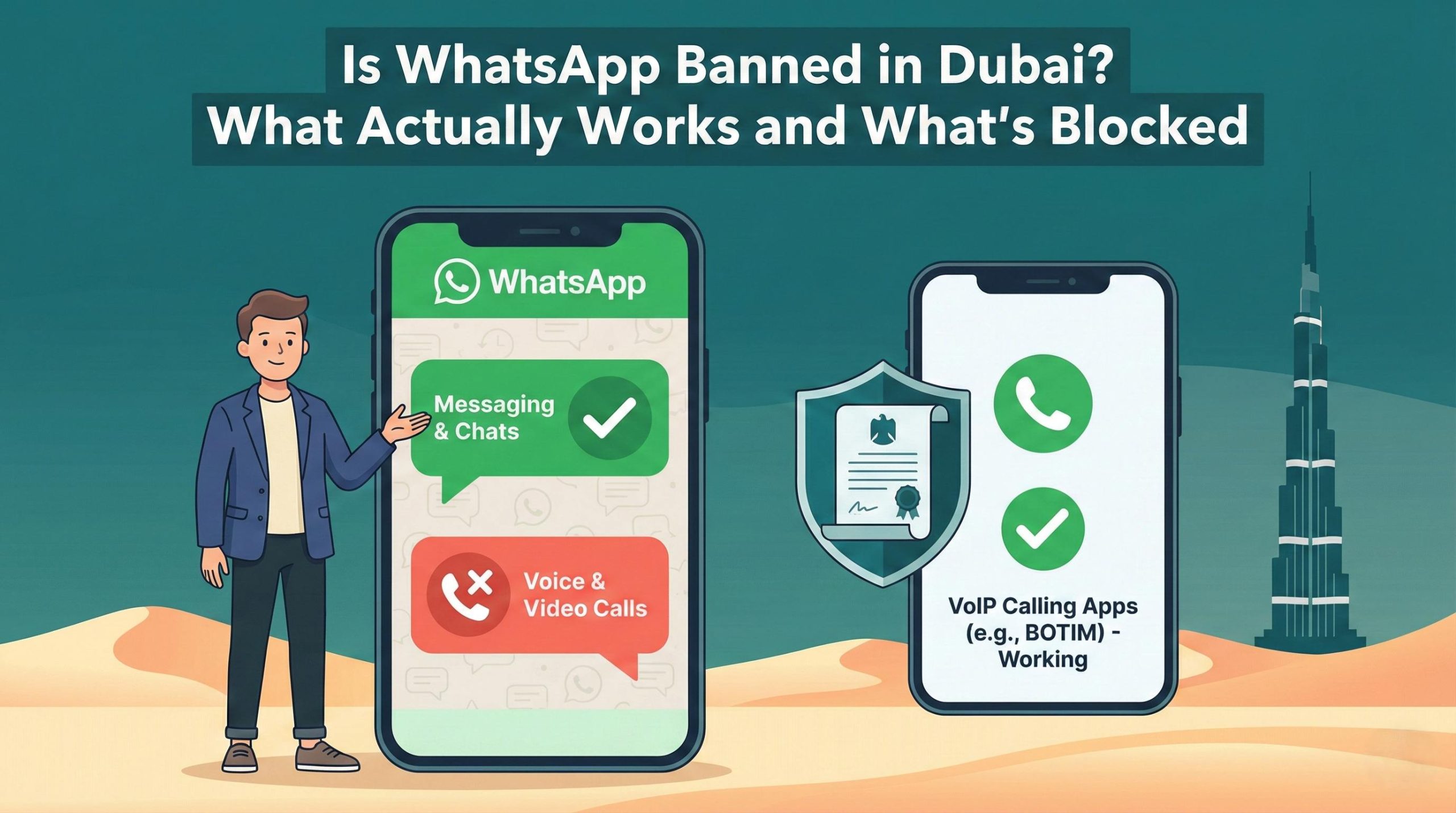
WhatsApp voice and video calls do not work in Dubai and across the UAE – not because of a technical glitch, but as a matter of government policy. The UAE’s Telecommunications and Digital Government Regulatory Authority (TDRA) blocks all unlicensed Voice over Internet Protocol (VoIP) services, including WhatsApp, FaceTime, Skype and Facebook Messenger.
This guide explains the legal, security and economic reasons behind the ban, lists what still works on WhatsApp, provides a complete overview of TDRA‑approved alternatives (BOTIM, GoChat, C’Me, Voico, Zoom, Microsoft Teams) and outlines the severe penalties for using a VPN to bypass the block. All information is current for 2026.
Table of Contents
WhatsApp vs. Legal Alternatives
The table below compares WhatsApp’s blocked features with the most popular TDRA‑approved apps.
| Feature | WhatsApp (UAE) | BOTIM | GoChat | C’Me | Zoom (Free) |
|---|---|---|---|---|---|
| Voice & video calls | Blocked | Yes | Yes | Yes | Yes |
| Text messaging | Yes | Yes | Yes | Yes | Limited (chat only) |
| Group calls | Blocked | Up to 8 participants | Yes | Yes | Up to 100 participants |
| End‑to‑end encryption | Yes | No (operator accessible) | No | No | Limited |
| Monthly cost | Free (text works) | ~50 AED | Free | Subscription | Free tier available |
Why Are WhatsApp Calls Blocked in Dubai and the UAE?
The UAE’s regulatory framework for internet communication is among the strictest in the world. Under Federal Decree‑Law No. 34 of 2021 (Concerning the Fight Against Rumours and Cybercrime) and the TDRA’s VoIP Policy, any application that offers voice or video calling must obtain a license from the TDRA and partner with one of the two licensed telecom operators – Etisalat by e& (formerly Etisalat) or du. WhatsApp has never applied for such a license, nor has it entered into a commercial agreement with either operator. Consequently, its voice and video call features are actively blocked at the network level. The block is not applied to text messaging, photo sharing, voice notes or document transfers – only real‑time voice and video streams.
Security and Surveillance
The UAE government cites national security as the primary justification for the block. WhatsApp employs end‑to‑end encryption by default, meaning that neither Etisalat, du, nor the government can intercept or monitor the content of calls. Authorities maintain that unmonitored encrypted communication channels could be exploited by criminal networks, terrorist organisations or foreign intelligence services. The TDRA explicitly requires that all licensed VoIP services provide a mechanism for lawful interception. Since WhatsApp refuses to compromise its encryption, it remains banned.
Economic Protection of Local Telecom Operators
The block also protects the revenue of Etisalat and du, both of which have invested heavily in their own licensed VoIP platforms. If WhatsApp calls were allowed for free, it would cannibalise international calling revenues and undercut paid services like BOTIM, which operates on a subscription model that shares revenue with the local operators. The UAE’s telecom sector is a significant contributor to the national economy, and the government has consistently prioritised its financial interests.
What Still Works on WhatsApp in the UAE?
Despite the call ban, most of WhatsApp’s core messaging features remain fully functional.
- Text messaging – one‑on‑one and group chats work normally.
- Voice notes – you can record and send voice clips.
- Photos and videos – sending media files is not blocked.
- Documents and files – sharing PDFs, spreadsheets and other attachments works.
- WhatsApp Web – the desktop version allows messaging without restrictions.
Voice and video calls – both one‑on‑one and group calls – are completely blocked on all networks (Wi‑Fi and mobile data) across the UAE.
Other Popular Apps That Are Blocked
WhatsApp is not alone. The TDRA’s VoIP policy applies equally to any unlicensed service offering real‑time audio or video communication.
| App / Service | Voice & Video Call Status (2026) |
|---|---|
| Apple FaceTime | Completely blocked on all UAE networks; Apple removes FaceTime from iPhones sold locally. |
| Skype (consumer version) | Blocked; only Skype for Business (now Microsoft Teams) is permitted.\xca |
| Facebook Messenger calls | Blocked. |
| Telegram calls | Blocked |
| Viber calls | Blocked |
| Google Duo / Google Meet (consumer app calls) | Consumer‑to‑consumer calls blocked; Meet for business works |
Legal Alternatives: TDRA‑Approved VoIP Apps
The following applications are fully licensed by the TDRA and work without any VPN or workaround. They are safe, legal and actively supported by Etisalat and du.
Consumer‑Facing Approved Apps
| App Name | Key Features | Pricing Model |
|---|---|---|
| BOTIM | One of the most popular VoIP apps in the UAE; supports HD audio/video calls, group calls up to 8 participants, screen sharing and messaging. | Subscription required (approx. 50 AED/month); often bundled with home internet plans. |
| GoChat Messenger | Launched by Etisalat; free voice and video calls, group chats, file sharing. | Free. |
| C’Me | Government‑approved, works on Etisalat and du networks; offers one‑on‑one and group calling, messaging and media sharing. | Subscription required. |
| Voico | Supports cross‑platform voice/video calls; available for iOS, Android, Windows and Mac. | Paid subscription. |
| HiU | Etisalat‑backed app often pre‑installed on certain Android phones sold in the UAE; voice/video calls and messaging. | Freemium (some features free). |
| UAE Voice | Originally launched by Etisalat during the COVID‑19 pandemic; still functional for free video/audio calling | Free |
Business and Professional Platforms (Approved)
These platforms are widely used for remote work and are generally allowed, provided they serve legitimate business purposes. They are not blocked.
- Microsoft Teams – Full video conferencing, screen sharing, chat. Free tier allows 60‑minute meetings for up to 100 participants.
- Zoom – Approved for video meetings. Free tier allows 40‑minute meetings for up to 100 participants.
- Google Meet – Accessible via any Google account; works on web and mobile apps. No restrictions.
- Cisco Webex – Fully functional; popular for corporate use.
- Slack (voice/video calls) – Huddles and video calls work, though primarily designed for team communication.
Can You Use a VPN to Make WhatsApp Calls? Legal Risks & Penalties
While a VPN can technically bypass the block by hiding your IP address, doing so is illegal under UAE law. The relevant provisions fall under Federal Decree‑Law No. 34 of 2021.
Penalties for Using a VPN to Access Blocked VoIP Services
- Article 10: Anyone who uses a fraudulent IP address or VPN to commit a crime or conceal evidence faces imprisonment and/or a fine of AED 500,000 – 2,000,000.
- Article 12: Accessing prohibited communication services (including blocked VoIP) via a VPN can lead to a prison term of at least one year and/or a fine of AED 250,000 – 1,000,000.
- Article 5: Interfering with telecommunications networks to bypass content filtering carries a fine of AED 100,000 – 500,000.
In practice, enforcement against individual tourists is rare, but there have been cases of fines and detention, especially when VPNs are used for commercial or repeated bypass. Etisalat and du actively block common VPN protocols; even when a VPN connects, call quality is often poor.
Legal experts advise strongly against using VPNs to unblock WhatsApp calls. The approved alternatives (BOTIM, GoChat, etc.) are legal, reliable and remove any risk.
Practical Advice: How to Stay Connected Legally in Dubai
If you are a resident or a tourist in Dubai, follow these steps to make internet calls without breaking the law:
- For personal calls to family and friends: Download BOTIM, GoChat, C’Me, Voico or HiU. Most are available on the Apple App Store and Google Play Store. BOTIM is the most widely used and works reliably on both Wi‑Fi and mobile data.
- For business meetings: Use Microsoft Teams, Zoom or Google Meet. All are fully functional and commonly used by companies in the UAE.
- If you need to call someone abroad who only has WhatsApp: Ask them to install BOTIM or GoChat. Both apps are free to download for them as well. You can also use regular international calling from your Etisalat or du SIM – international add‑on packages start from as low as AED 30.
- Continue using WhatsApp for text messaging, photos and documents. Those features are completely unaffected.
Will the WhatsApp ban ever be lifted?
As of 2026, there are no official signs of a policy change. The TDRA has repeatedly reaffirmed its stance that all VoIP services operating in the UAE must be licensed and must comply with local regulatory and security requirements. WhatsApp has not indicated any willingness to modify its encryption or to partner with local telecom operators. Therefore, WhatsApp voice and video calls are expected to remain blocked for the foreseeable future. The safest and most efficient solution is to use approved alternatives.
Frequently Asked Questions
Can I make WhatsApp calls if I am a tourist with a foreign SIM card on roaming?
No. The block is applied at the network level by Etisalat and du regardless of the SIM card’s origin. If your phone connects to a UAE mobile network (Etisalat or du) or to a UAE Wi‑Fi network, the VoIP block applies. The only exception is if you use a foreign SIM that roams on a non‑UAE network (e.g., a Saudi SIM roaming on a Saudi network while you are physically in the UAE) – but that is impractical for most users.
Is FaceTime blocked in Dubai?
Yes. FaceTime has been completely blocked for years. Apple also sells a version of iPhones in the UAE that does not have the FaceTime app at all.
Are there any free legal VoIP apps?
Yes. GoChat and UAE Voice are completely free. BOTIM requires a paid subscription (approx. 50 AED/month), and C’Me and Voico also have subscription fees. For business, Zoom and Teams free tiers offer generous limits.
Understanding why WhatsApp calls are banned in Dubai is the first step to staying connected legally. By switching to TDRA‑approved alternatives, you avoid legal risks, hefty fines and the unreliability of VPN workarounds. Choose BOTIM or GoChat for personal calls, Teams or Zoom for business, and keep using WhatsApp for text messaging. This approach is fully compliant, secure and tested by millions of residents and visitors every day.