
Dubai is the world’s fourth-largest saffron trading hub, and most of the Iranian saffron that reaches Europe andWhere to Buy North America passes through this city first. That means the saffron you buy here is fresher, cheaper, and closer to the source than almost anywhere else — but it also means the market is flooded with fakes, dyed threads, and low-grade powder sold as premium Negin. This guide covers where to buy the real thing, how to tell genuine saffron from adulterated strands, and what you should pay per gram in 2026
Table of Contents
At A Glance: Where To Buy Original Saffron In Dubai
| Location | Best For | Price Per Gram (AED) | What You Get |
|---|---|---|---|
| Spice Souk, Deira | Loose, negotiable, wide choice | 15 – 40 | Sargol and Negin grade, buy by weight |
| Carrefour & Lulu Hypermarket | Sealed, branded, consistent | 25 – 60 | Pre-packaged Iranian saffron with certification |
| Iranian Speciality Stores | Direct import, premium Negin | 30 – 80 | Top-grade Negin, often vacuum-sealed |
| Global Village (seasonal) | Specialist stalls, Iranian Pavilion | 20 – 50 | Direct from Iranian vendors, seasonal |
| Duty-Free (DXB Airport) | Last-minute, guaranteed genuine | 35 – 70 | Certified, sealed, premium packaging |
| Online (Noon, Amazon.ae) | Convenience, branded | 20 – 50 | Check seller ratings and origin labels |
Where The Real Saffron Is Sold
Spice Souk — Deira’s Historic Spice Market
The Spice Souk in Deira is the most atmospheric place to buy saffron in Dubai. Dozens of small stalls sell saffron loose from large glass jars, and the vendors are generally knowledgeable about the grades they carry.
The advantage here is price and choice. You can examine the threads before buying — hold them in your hand, smell them, check the colour. Vendors weigh exactly what you want, and a 2-gram purchase is perfectly acceptable. Prices range from AED 15 to 40 per gram depending on grade and your bargaining skills. The starting price is rarely the final price; a quoted AED 30 per gram can often settle at AED 20 to 25. The disadvantage is that you must know how to identify genuine saffron yourself. Reputable stalls exist alongside those selling lower-grade product, and the responsibility for quality control sits with the buyer.
- Location: Deira, near the Gold Souk and abra station
- Price Range: AED 15 – 40 per gram (negotiable)
- Best For: Loose saffron, buying by weight, bargaining
- Tip: Visit 3–4 stalls before buying. Compare colour, smell, and price. A good vendor will let you rub a thread between your fingers.
Iranian Speciality Stores — Direct From The Source
Scattered across Deira, Bur Dubai, and Satwa, Iranian grocery stores and speciality shops sell saffron imported directly from farms in Khorasan. These shops often have the best prices on premium Negin grade, and the product is typically vacuum-sealed in small packets to preserve freshness.
These stores cater primarily to Iranian expatriates who know their saffron, so the quality tends to be consistently high. The packaging is less polished than supermarket brands — often just a clear plastic packet with a simple label — but the threads inside are deep red, aromatic, and genuine. Prices for Negin grade run AED 30 to 80 per gram depending on the harvest year and quality. The shops near the Iranian Mosque in Satwa and along Al Muraqqabat Road in Deira are good starting points. Staff will usually open a packet for you to inspect before purchasing.
- Locations: Satwa (near Iranian Mosque), Al Muraqqabat Road (Deira), Bur Dubai
- Price Range: AED 30 – 80 per gram for Negin
- Best For: Premium-grade saffron at fair prices, direct import
- Tip: Look for vacuum-sealed packaging. Saffron exposed to air loses potency quickly.
Supermarkets — Carrefour, Lulu, And Spinneys
Carrefour, Lulu Hypermarket, and Spinneys sell pre-packaged saffron from established brands with clear origin labelling. The advantage is consistency and convenience — you do not need to haggle or inspect threads under a shop light. The product is sealed, certified, and traceable to its source.
Carrefour stocks Iranian saffron in its gourmet section, with 1-gram and 2-gram jars priced at AED 25 to 50 per gram depending on grade. Lulu Hypermarket carries its own branded saffron alongside imported Iranian and Spanish varieties, typically at AED 20 to 40 per gram. Spinneys positions itself at the higher end, with premium organic and certified saffron at AED 40 to 60 per gram. These prices are fixed — no bargaining — and the saffron is reliably genuine if not always the freshest batch available. For those who want certainty over the lowest possible price, supermarkets are the safest choice.
- Best Stores: Carrefour (Mall of the Emirates, Deira City Centre), Lulu Hypermarket (Al Barsha, Karama), Spinneys (multiple locations)
- Price Range: AED 20 – 60 per gram
- Best For: Sealed, certified saffron with clear origin labelling
- Tip: Check the harvest date on the label. Saffron older than two years has lost significant potency.
Global Village — Seasonal Iranian Pavilion
Global Village operates from approximately October to May each year, and its Iranian Pavilion houses several stalls selling saffron imported directly from Iran. The vendors are often Iranian themselves, and they bring product that ranges from everyday Sargol to premium Negin.
The seasonal nature of Global Village means the saffron here tends to be from the most recent harvest, which runs in October and November. Prices are competitive — AED 20 to 50 per gram — and the atmosphere is more relaxed than the Spice Souk. Vendors expect some bargaining but are less aggressive than their Deira counterparts. The pavilion also sells Iranian nuts, dried fruits, and rosewater, making it a good stop for stocking up on multiple pantry items. The disadvantage is that Global Village is only open for half the year and is located on the outskirts of the city.
- Location: Global Village, Sheikh Mohammed Bin Zayed Road (seasonal: October – May)
- Price Range: AED 20 – 50 per gram
- Best For: Fresh-harvest saffron, direct from Iranian vendors
- Tip: Go early in the season (November) for the freshest product from the autumn harvest.
Dubai International Airport — Last-Minute Guaranteed Genuine
The duty-free shops at Dubai International Airport (DXB) sell saffron that is certified, sealed, and guaranteed authentic. The packaging is premium, and the branding is clear — Bateel, Camel, and dedicated saffron brands all appear on the shelves.
The price at the airport is higher than anywhere else in the city: AED 35 to 70 per gram. You are paying for certainty, convenience, and the guarantee that the saffron is genuine. For travellers who forgot to buy saffron earlier or who want a last-minute gift with no risk of adulteration, the airport is a reliable option. The selection is smaller than the Spice Souk — typically one or two brands in a few sizes — but the quality is consistent. Duty-free pricing removes the tax component, though the base price is still elevated compared to street-level shops.
- Location: Dubai International Airport (DXB), Terminals 1, 2, and 3
- Price Range: AED 35 – 70 per gram
- Best For: Last-minute purchase, guaranteed genuine, premium packaging
- Tip: Buy here only if you forgot elsewhere. The price premium is significant.
How To Identify Original Saffron
The Six Tests For Genuine Threads
Fake saffron is a global problem, and Dubai’s markets are not immune. Adulterated saffron may contain dyed corn silk, coconut fibres, safflower petals, or even shredded plastic. The following tests help you verify what you are buying before you hand over your money.
The Cold Water Test
Drop 3 to 5 threads into a small glass of cold water. Genuine saffron releases a slow, steady stream of golden-yellow colour over several minutes. The threads themselves remain intact and red. Fake saffron releases colour instantly — within seconds — and often turns the water bright red or orange. This is the most reliable test and can be performed at home with a single gram.
The Rub Test
Rub a few threads between your thumb and forefinger. Genuine saffron threads are dry and brittle but do not disintegrate into powder. If the threads turn to dust or leave a bright orange stain on your skin, they have been dyed. Your fingers should smell sweet and slightly medicinal after rubbing the threads — not musty, metallic, or like tobacco.
The Baking Soda Test
Dissolve a pinch of baking soda in a glass of water, then add a few saffron threads. Genuine saffron turns the water yellow. Fake saffron often turns it red or pink because the chemical dyes used in adulteration react with the alkaline baking soda.
The Taste Test
Place a single thread on your tongue. Genuine saffron tastes slightly bitter and medicinal — never sweet. If the thread tastes sweet or sugary, it has been coated to add weight. If it tastes like nothing at all, it is likely not saffron.
The Appearance Check
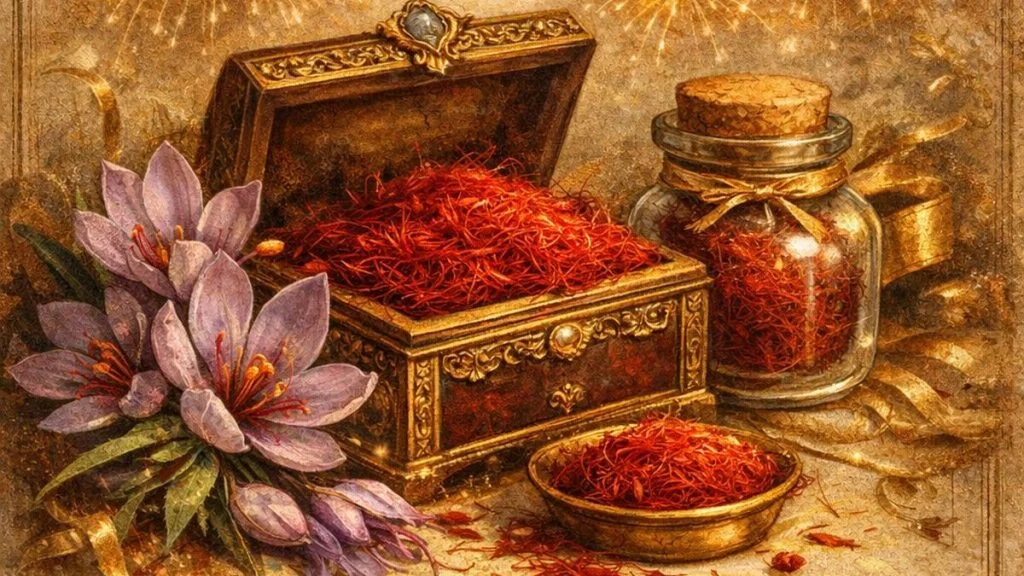
Genuine saffron threads are deep red with one end that flares into a lighter orange or yellow trumpet shape. Each thread is a dried stigma — the female part of the Crocus sativus flower — and should look like a tiny, curled strand. Uniformly red threads with no colour variation are suspicious. Threads that are all the same length, perfectly straight, and identical in colour are likely machine-cut dyed material.
The Smell Test
Open the jar or packet and inhale. Genuine saffron smells like a combination of honey, hay, and a slightly medicinal earthiness. It should never smell musty, mouldy, metallic, or like tobacco. If the saffron has no smell at all, it is old or fake. If the smell is overpoweringly sweet, it may have been sprayed with a flavouring agent to mask adulteration.
- Cold Water Test: Genuine saffron releases colour slowly over minutes. Fake releases colour instantly.
- Rub Test: Genuine threads stay intact. Fake disintegrates or stains your fingers.
- Baking Soda Test: Genuine turns water yellow. Fake turns water red or pink.
- Taste Test: Genuine is bitter and medicinal. Fake is sweet or flavourless.
- Appearance: Genuine is uneven, curled, with orange tips. Fake is uniform and straight.
- Smell: Genuine smells of honey and hay. Fake smells musty, metallic, or of nothing.
Saffron Grades Explained
Negin, Sargol, Pushal — What The Names Mean
Iranian saffron is classified into several grades based on which part of the stigma is included. Understanding these grades helps you understand what you are paying for.
Negin is the highest grade. It consists entirely of the deep red tips of the stigma, with no yellow or orange parts. The threads are long, thick, and uniform in colour. Negin has the highest concentration of crocin — the compound responsible for colour — and safranal, which gives saffron its aroma. It is the most expensive grade, typically AED 30 to 80 per gram.
Sargol is the next grade down. It is still all-red, but the threads are shorter and may include small fragments from the tips. Sargol has excellent colouring power and is the most commonly sold premium grade in Dubai. It costs AED 15 to 40 per gram.
Pushal (or Pushali) includes the red stigma with a small amount of the yellow style attached. The threads are longer because the yellow part is not trimmed off, but the colouring power is lower per gram because the yellow portion contains less crocin. Pushal is cheaper — AED 10 to 25 per gram — and is often sold as everyday saffron.
Bunch saffron (Dasteh) is the lowest grade: whole stigmas with the full yellow style attached, dried and bundled into small bunches. It looks attractive but has the least colouring power per gram. Powdered saffron is not a grade — it is usually made from low-quality or broken threads, and it is the most commonly adulterated form. Avoid buying saffron powder unless you trust the source completely.
| Grade | Composition | Quality | Price Per Gram (AED) |
|---|---|---|---|
| Negin | All-red, long, thick stigma tips | Highest | 30 – 80 |
| Sargol | All-red, shorter threads | Premium | 15 – 40 |
| Pushal | Red stigma with yellow style attached | Good everyday | 10 – 25 |
| Bunch (Dasteh) | Whole stigma with full yellow style | Lowest colouring power | 8 – 15 |
How To Store Saffron
Keeping It Potent For Years
Saffron loses its potency when exposed to light, air, heat, and moisture. Properly stored, it can retain its colour and aroma for two to three years. Stored badly, it fades within months.
Keep saffron in an airtight glass jar, not plastic — glass does not absorb the volatile oils. Store the jar in a cool, dark cupboard away from the stove and direct sunlight. Never refrigerate or freeze saffron; condensation forms when the jar is opened and moisture degrades the threads. A small 2-gram jar kept in these conditions will stay potent through two years of regular use. If you buy a larger quantity, consider dividing it into two jars — one for daily use and one sealed for longer storage.
- Use an airtight glass jar, not plastic.
- Store in a cool, dark cupboard away from heat and light.
- Never refrigerate or freeze — moisture destroys saffron.
- Divide large quantities into two jars: one for use, one sealed.
- Properly stored saffron lasts 2–3 years.
How To Buy Saffron In Dubai
A Practical Step-By-Step Guide
Decide which grade you want before you shop. If you are buying saffron for everyday cooking — rice, tea, stews — Sargol is the best balance of quality and price. If you are buying a gift or want the highest possible colouring power, Negin is worth the premium. Avoid buying saffron powder entirely unless you see the threads ground in front of you.
Buy threads, not powder. Whole threads are much harder to adulterate, and you can test them on the spot. A 2-gram jar is enough for four to six months of regular cooking. A 5-gram jar will last a year or more. Saffron is measured by the gram — a little goes a very long way.
At the Spice Souk or a speciality store, ask to see the threads before buying. A reputable vendor will open a jar for you. Perform the rub test on the spot and smell the threads. If the vendor refuses to let you examine the product, walk away. At a supermarket, check the harvest date on the label. Saffron harvested more than two years ago has lost significant potency. The packaging should list the country of origin — Iran, specifically the Khorasan region, is the gold standard.
Store your saffron correctly from the moment you get home. Transfer it to a glass jar if it came in plastic. Keep it in a cupboard. Use it sparingly — 5 to 7 threads are enough for a pot of rice that serves four people. Bloom the threads in a tablespoon of warm water or milk for 10 to 15 minutes before adding them to your dish. This releases the colour and aroma fully.
- Choose your grade: Sargol for daily use, Negin for gifts or maximum quality.
- Buy threads, never powder.
- Buy 2–5 grams — saffron is potent and a little goes far.
- Inspect before buying: rub test, smell test, check colour.
- Check harvest date and origin on packaged saffron.
- Store in a glass jar in a dark cupboard immediately.
- Bloom threads in warm water or milk before cooking.
Dubai is one of the best cities in the world to buy original saffron. The product is fresher, the prices are lower, and the selection is wider than almost anywhere outside Iran itself. The trade-off is that the market contains fakes, and the responsibility for telling them apart sits with you. Learn the cold water test. Buy threads, not powder. Smell before you pay. A 2-gram jar of genuine Iranian Negin saffron costs AED 30 to 80 and will flavour your cooking for months. That is a fraction of what you would pay in a European or North American supermarket for a product that has travelled further and sat on a shelf longer. Go to the Spice Souk for the experience and the bargaining. Go to a supermarket for certainty. Go to an Iranian speciality store in Satwa for the best combination of price and quality. Wherever you go, inspect what you are buying — and enjoy the small, vivid threads that have been worth more than gold for a thousand years.