

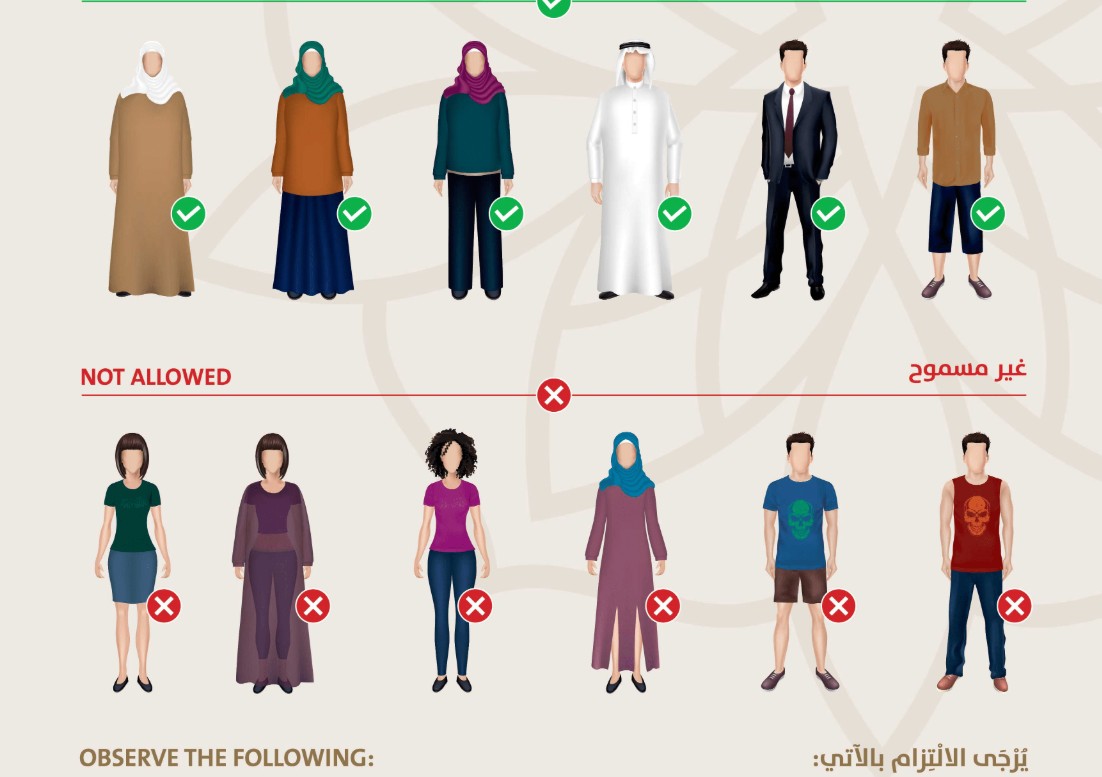
Jumeirah Mosque is the only mosque in Dubai that actively welcomes non‑Muslim visitors through guided tours, and it has a strict but simple dress code. The rules apply to everyone over the age of five, and free traditional clothing is provided at the entrance if your own outfit does not comply. This guide covers what men, women, and children need to wear, what the mosque provides, and how to avoid being turned away.
At A Glance: The Rules For Everyone
| Body Area | Women | Men |
|---|---|---|
| Head | Must be covered. Scarf or shayla required. | No head covering required. |
| Shoulders & Upper Arms | Must be fully covered. | Must be fully covered. |
| Torso | Loose, opaque clothing. No see‑through fabrics. | Loose, opaque clothing. No vests. |
| Legs | Must be covered to the ankles. | Must be covered to below the knees. |
| Feet | Covered or barefoot inside. Shoes off at entrance. | Covered or barefoot inside. Shoes off at entrance. |
Dress Code For Women
What You Must Cover?
Women must cover their hair, arms, and legs completely. A headscarf is required — it must cover all hair and be secured so it does not slip during the tour. Long‑sleeved tops that reach the wrists and full‑length trousers or skirts that cover the ankles are the standard expectation. Loose, opaque clothing is essential. Tight‑fitting clothes, leggings worn alone, and transparent or sheer fabrics are not acceptable, even if the skin underneath is covered.
The mosque provides a traditional black abaya and a shayla headscarf free of charge. These are available at the entrance and do not need to be reserved in advance. You put them on over your existing clothes. If you are wearing a long‑sleeved top and full‑length trousers, you will still be given an abaya to wear. The abaya is the standard garment provided to all female visitors regardless of their existing outfit — it is not a punishment for getting the dress code wrong; it is simply how the mosque ensures consistency and respect for the space. You do not need to bring your own scarf or robe unless you prefer to.
- Hair must be fully covered with a scarf or shayla.
- Arms must be covered to the wrists.
- Legs must be covered to the ankles.
- Clothing must be loose and opaque.
- No tight leggings, no sheer fabrics, no short sleeves, no low necklines.
- Free abaya and headscarf provided at the entrance.
Dress Code For Men
What You Must Cover?
Men must cover their shoulders and knees. A t‑shirt with sleeves that cover the shoulders is the minimum acceptable top. Long trousers or jeans that reach below the knee are required. Shorts are not permitted unless they extend below the knee. Vests, sleeveless tops, and any top that exposes the shoulders are not allowed.
Men do not need to cover their heads. There is no requirement for a kufi cap or any other head covering. If a man arrives in shorts that end above the knee, or in a sleeveless top, the mosque will provide a traditional kandura — the white ankle‑length robe worn by Emirati men — or a pair of long trousers to wear over the shorts. These are free and available at the entrance. Most men who come wearing full‑length trousers and a t‑shirt will enter in their own clothes without needing to change.
- Shoulders and upper arms must be covered. No vests, no sleeveless tops.
- Legs must be covered below the knee. No shorts above the knee.
- No head covering is required.
- Free kandura or long trousers provided if your outfit does not comply.
Dress Code For Children
What Kids Should Wear?
Children under the age of five are not expected to follow a strict dress code. For children aged five and older, the same rules apply as for adults — girls should cover their hair, arms, and legs; boys should cover their shoulders and knees. The mosque does not provide child‑sized abayas or kanduras, so it is best to dress children appropriately before arriving. If a child aged five or older arrives in shorts or a sleeveless top, the mosque staff may provide an adult‑sized covering that can be draped over them.
- Under 5: No formal dress code.
- Age 5 and above: Same rules as adults. Dress them appropriately before arriving.
- Child‑sized coverings are not provided.
Shoes And Footwear
What Happens At The Entrance?
Everyone removes their shoes before entering the mosque prayer hall. Shoe racks are provided at the entrance, and the practice is the same for men, women, and children. You do not need to wear specific footwear — trainers, sandals, and formal shoes are all fine because they will be removed anyway. Socks are not required but may be more comfortable on the carpeted floor. The mosque floor is clean, carpeted, and well‑maintained.
- Shoes must be removed before entering the prayer hall.
- No specific footwear required.
- Socks are optional but comfortable on the carpet.
What The Mosque Provides?
Clothing Given At The Entrance
Traditional clothing is provided free of charge to every visitor who needs it. For women, this is a black abaya and a shayla headscarf. For men who do not meet the dress code, it is a white kandura or a pair of long trousers. These garments are loaned for the duration of the tour and must be returned at the end. They are clean, well‑maintained, and available in a range of sizes. You do not need to book in advance or pay a deposit. You simply put them on over your existing clothes before entering the mosque.
If you already arrive fully covered according to the mosque rules — long sleeves, full‑length trousers, and a secured headscarf for women — you may not need to change. In practice, almost all female visitors are asked to wear the abaya regardless, as a matter of consistency and respect. Men who arrive in full‑length trousers and a sleeved top will typically enter in their own clothes.
- Women: Free abaya and shayla headscarf.
- Men: Free kandura or long trousers if needed.
- Provided at the entrance. No booking. No deposit. Return after the tour.
- Worn over your existing clothes.
If You Do Not Follow The Dress Code
What Happens When You Arrive?
The staff at Jumeirah Mosque are welcoming and will not turn you away for dress code violations. If you arrive in clothing that does not meet the requirements, you will simply be asked to wear the traditional garments provided. There is no judgment, no fine, and no rejection. The system is designed to be inclusive and educational, not punitive.
That said, arriving in overly revealing clothing — swimwear, beachwear, or very short shorts — is not advisable. While you will still be given covering, the process takes a few minutes, and you may feel uncomfortable in the brief period before you are dressed. Covering up before you arrive is a sign of respect for the mosque as a place of worship. The key point is that nothing about the dress code is designed to catch anyone out. It is practical, fair, and consistently applied to everyone.
- You will not be turned away.
- If your outfit does not comply, you will be given traditional clothing to wear.
- No fines, no rejection, no judgment.
- Avoid swimwear and very short shorts out of respect.
Practical Tips For Your Visit
What To Know Before You Go?
The Jumeirah Mosque tour is operated by the Sheikh Mohammed Centre for Cultural Understanding (SMCCU). Tours run at 10:00 AM and 2:00 PM from Saturday to Thursday, with no tours on Friday. Registration opens 30 minutes before each tour, and no prior booking is required for individuals or small groups. Large groups should book in advance through the SMCCU website. The cost is AED 40 per person, and the tour lasts approximately 75 minutes. It includes Emirati refreshments — Arabic coffee, dates, and pastries — at the end.
Photography is allowed both inside and outside the mosque. Dress comfortably but conservatively. If you plan to take photographs, consider how your outfit will look under an abaya — it will not be visible, so the only clothing that matters for the tour itself is what the mosque provides. Carry a small bag for your shoes. The mosque is air‑conditioned and comfortable year‑round. Ramadan timings may differ, so check the SMCCU website during the holy month. Arrive 15 minutes before the tour starts to allow time for parking, dressing, and shoe removal.
- Tour Operator: Sheikh Mohammed Centre for Cultural Understanding (SMCCU).
- Tour Times: 10:00 AM and 2:00 PM, Saturday to Thursday. No tours on Friday.
- Cost: AED 40 per person. Registration opens 30 minutes before.
- Duration: Approximately 75 minutes. Includes refreshments.
- Photography: Allowed inside and outside.
- Ramadan: Timings may change. Check the SMCCU website.
- Arrival: 15 minutes before the tour start time.
Jumeirah Mosque is one of the most visitor‑friendly religious sites in the Gulf, and its dress code reflects that. It asks for nothing complicated — covered shoulders, covered knees, covered hair for women — and it provides the clothing you need if you do not have your own. The system exists to make the mosque accessible, not to create obstacles. Dress respectfully, arrive on time, and let the mosque’s architecture, the guide’s storytelling, and the Emirati hospitality at the end of the tour do the rest.


