
Seven pens. One document. A nation born on this exact spot on December 2, 1971. The Etihad Museum stands on the very ground where the rulers of the emirates signed the UAE Constitution and raised the first flag. It is not a general history museum — it tells one story with exceptional depth and modern technology, and it is one of the few places on earth where you stand physically at the birthplace of a country.
This guide covers everything: architecture, the eight underground pavilions, Union House, ticket prices, guided tours, transport, and the practical details that make a visit seamless.
At A Glance: Quick Facts
| Detail | Information |
|---|---|
| Address | 1 Jumeira Road, Jumeirah 1, Dubai |
| Managed By | Dubai Culture & Arts Authority |
| Opened | January 7, 2017 (inaugurated December 2, 2016) |
| Architect | Moriyama & Teshima Architects (Canada) |
| Total Area | 25,000 square metres |
| Permanent Pavilions | 8 |
| Adult Ticket | AED 25 |
| Child Ticket (3–12) | AED 10 |
| Children Under 3 | Free |
| Group Rate (5+) | AED 20 per person |
| Student Rate | AED 10 (with valid student card) |
| Opening Hours | Mon–Thu, Sat–Sun: 10:00 AM – 8:00 PM; Friday: 2:00 PM – 8:00 PM |
| Nearest Metro | Financial Centre Metro Station (Red Line) — 5‑minute walk |
| Average Visit Duration | 1.5 – 2.5 hours |
| Parking | Free on‑site parking |
| Official Website | etihadmuseum.dubaiculture.gov.ae |
Where History Was Signed
The Union House And The Site
On December 2, 1971, the rulers of six emirates — Abu Dhabi, Dubai, Sharjah, Ajman, Umm Al Quwain, and Fujairah — gathered at what was then known as the Jumeirah Guesthouse or Al Diyafah Palace. They signed the Constitution of the United Arab Emirates, and the first UAE flag was raised on the same ground. Ras Al Khaimah joined the federation in February 1972, completing the union of seven.
The modest white circular building where that signing took place — the Union House — still stands today, preserved and restored within the museum complex. The original flagpole from which the first UAE flag flew remains on the site. It bears the very flag that the founding fathers gathered beneath after the formation of the nation.
The Guest House, where the leaders resided during the negotiations, has also been restored to its original condition. With special permission, visitors can enter the restored oval‑shaped Union House and stand in the room where the constitution was actually signed. The contrast between that simple structure and the sweeping modern museum that surrounds it creates a powerful visual narrative of the UAE’s transformation.
- Union House: Original circular building where the Constitution was signed. Preserved within the museum grounds. Entry by guided tour.
- Guest House: Restored building where leaders stayed during negotiations.
- Original Flagpole: The actual pole and flag from December 2, 1971, still standing on the site.
A Manuscript Carved In Stone
Architecture By Moriyama & Teshima
The Etihad Museum was designed by Moriyama & Teshima Architects, a Canadian firm known for creating spaces that reinforce civic identity. The building’s design is not abstract — every curve and column has a specific meaning tied to the UAE’s founding moment.
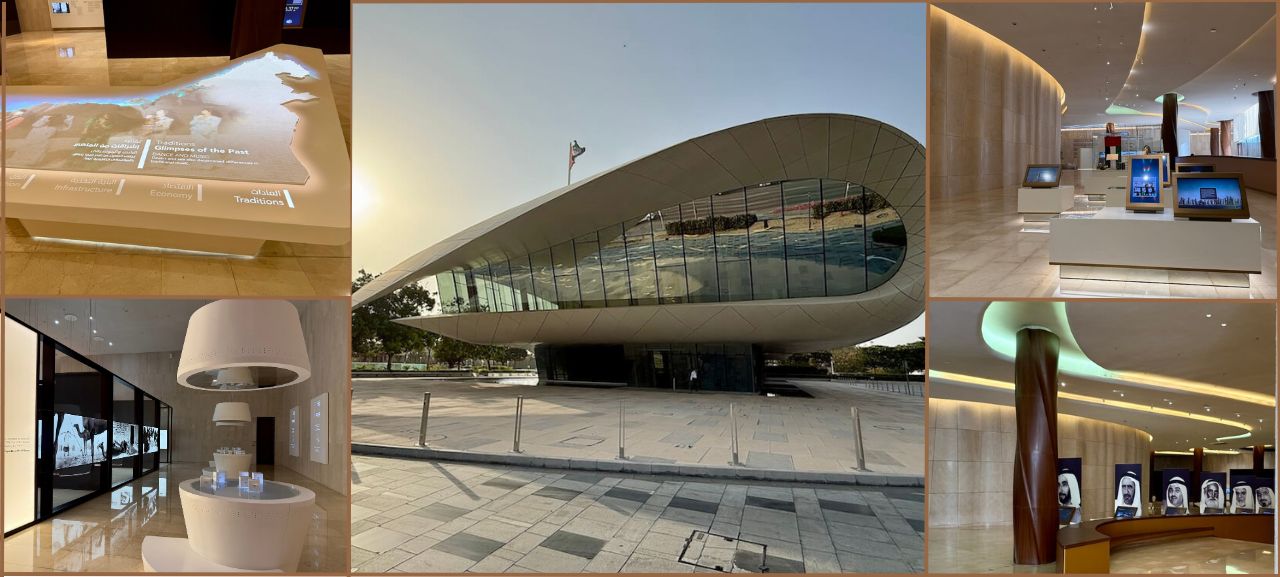
The entrance pavilion is shaped like an open manuscript, its undulating parabolic curves representing the parchment upon which the unification agreement was written. Seven tapering columns rise from the building, each symbolising one of the pens used by the founding fathers to sign the declaration. The golden exterior of the roof appears to float above the structure, changing its character as light shifts across its curved surface throughout the day.
Much of the museum — approximately 26,000 square metres — lies underground. This was a deliberate choice: placing the permanent and temporary galleries, theatre, event spaces, and archival facilities beneath the surface preserves the memory of the place and keeps the above‑ground landscape visually connected to the historic Union House. Lightwells of varying shapes and sizes illuminate the subterranean spaces, drawing natural light down into the exhibition halls and guiding visitors through the underground galleries.
The travertine plaza at ground level flows seamlessly into the pavilion, moving across terraced viewing platforms and through delicate bronze jali screens. The reflecting pool and surrounding landscape have been designed to recall the original 1971 shoreline of Jumeirah Beach, recreating the environment that existed when the founding fathers gathered here. A 123‑metre‑high golden pole bearing the UAE flag rises above the complex, visible from a considerable distance.
- Architect: Moriyama & Teshima Architects (Toronto, Canada)
- Design Concept: An open manuscript — the unification document — with seven columns as pens.
- Underground Area: Approximately 26,000 square metres of exhibition and archival space below ground.
- Golden Flagpole: 123 metres (403.5 feet) high. Bears the UAE flag visible across the waterfront.
- Plaza Features: Travertine surface, reflecting pool, bronze jali screens, terraced viewing platforms.
The Eight Pavilions
What Each Gallery Contains
The museum houses eight permanent pavilions that trace the story of the UAE’s formation in chronological order. Each pavilion uses interactive technology, original artefacts, and multimedia installations to bring a specific chapter of the union story to life.
Pavilion One opens with a documentary film that introduces the history of the UAE. Pavilion Two houses a panoramic interactive map showing the region before federation — the Trucial States era, when each emirate was a separate British protectorate. Pavilion Three presents an interactive timeline of key historical events leading up to the union decision. Pavilion Four provides an interactive guide to how the federation was actually formed, walking visitors through the negotiation and agreement process.
Pavilion Five pays tribute to the founding fathers and the challenges they faced before 1971. Pavilion Six is dedicated to the UAE Constitution itself and displays the actual signed declaration — the document that created the nation. Pavilion Seven is an open gallery celebrating the newborn nation in the years immediately following union. An eighth temporary gallery hosts travelling exhibitions from international museums, changing periodically to offer returning visitors something new.
Throughout the pavilions, large‑scale projections recreate the desert landscape where tribal leaders once lived. Holographic displays animate the founding fathers in discussion. Personal artefacts from the rulers — old passports, photographs, and personal items — sit alongside the constitution copy and interactive maps. Quotations from Sheikh Zayed bin Sultan Al Nahyan, the founding father of the UAE, adorn the walls.
- Pavilion One: Documentary film — the history of the UAE.
- Pavilion Two: Panoramic interactive map — the pre‑federation era.
- Pavilion Three: Interactive timeline — key events before the union.
- Pavilion Four: Interactive guide — the formation of the federation.
- Pavilion Five: Tribute — the founding fathers and their challenges.
- Pavilion Six: The UAE Constitution — includes the actual signed declaration.
- Pavilion Seven: Open gallery — celebrating the newborn nation.
- Temporary Gallery: Rotating exhibitions from international museums.
Exhibits, Library, And Guided Tours
What You Will See And Do Inside
The museum’s collection spans the period from 1968 to 1974, covering the years that led directly to the UAE’s formation and the first years of the federation. It holds tangible and intangible expressions of the founding story: original documents, personal artefacts belonging to the rulers, archival photographs, film footage, and artworks located throughout the museum.
Interactive videos, holographic films, and touch‑screen displays make the history accessible to visitors of every age and background. A virtual replica of the constitution in both Arabic and English can be read by visitors. Temporary exhibits have included displays of stamps from the Trucial States period, when the emirates were an important part of the air and sea route connecting the United Kingdom with India.
The museum library houses approximately 3,000 books on the UAE’s national and social history, along with magazines, CDs, and other research materials. It is open to visitors who wish to delve deeper into the country’s past. A lakeside café and restaurant on the upper level offers refreshments with a view over the reflecting pool and the waterfront. A retail shop sells books, souvenirs, and UAE‑themed gifts.
Guided tours of the museum and Union House take place daily at 11:00 AM, 1:00 PM, 3:00 PM, and 5:00 PM. These tours provide deeper insight into the constitutional process and its lasting impact. English and Arabic audio guides are included with admission. The museum also runs educational workshops and activities suitable for school groups and families.
- Guided Tours: Daily at 11:00 AM, 1:00 PM, 3:00 PM, and 5:00 PM. Includes Union House access.
- Audio Guides: Available in English and Arabic. Included with admission.
- Library: 3,000+ books on UAE history, plus magazines and CDs. Open to visitors.
- Café: Lakeside restaurant on the upper level with waterfront views.
- Retail Shop: Books, souvenirs, and UAE‑themed gifts.
- Workshops: Educational programmes for school groups and families.
Getting To The Museum
Metro, Bus, Taxi, And Parking
The Etihad Museum stands at 1 Jumeira Road, at the intersection of Jumeirah Street and 2nd December Street in Jumeirah 1. The site sits along Route D94, the road that runs parallel to the Jumeirah coastline.
The nearest Metro station is Financial Centre Metro Station on the Red Line, approximately a 5‑minute walk from the museum. Al Ghubaiba Metro Station on the Green Line is about a 7‑minute walk away. Several sources also reference Al Jafiliya Metro Station on the Red Line as reachable within a 10‑minute taxi ride. The Dubai Tram does not directly serve this area.
Multiple RTA bus routes stop within a 4‑to‑7‑minute walk of the museum. The Hudheiba – 01 bus stop is the closest at 272 metres. Buses C10, X13, X28, 7, 8, 12, C9, C15, and 88 all serve stops near the museum. Executive Court – 02 and Jumeira Rotana Hotel – 2 are the next nearest stops.
Free on‑site parking is available with ample spaces. A taxi or ride‑hailing service from most central Dubai locations reaches the museum in 10 to 15 minutes. The drive from Dubai International Airport takes approximately 10 to 15 minutes. From Dubai Marina, the journey is about 25 to 30 minutes by car.
- Address: 1 Jumeira Road, Jumeirah 1, Dubai. At the intersection of Jumeirah Street and 2nd December Street.
- Nearest Metro: Financial Centre Metro Station (Red Line) — 5‑minute walk. Al Ghubaiba Metro Station (Green Line) — 7‑minute walk.
- Nearest Bus Stop: Hudheiba – 01 — 272 metres, 4‑minute walk.
- Bus Routes: C10, X13, X28, 7, 8, 12, C9, C15, 88.
- Parking: Free on‑site parking with ample spaces.
- Taxi from DXB Airport: 10–15 minutes. From Dubai Marina: 25–30 minutes.
Tickets, Timings, And Booking
What To Know Before You Go?
The museum opens Monday to Thursday and Saturday to Sunday from 10:00 AM to 8:00 PM. On Fridays, the museum opens later — from 2:00 PM to 8:00 PM — with the morning period closed. These hours are consistent throughout the year, though Ramadan may bring slight adjustments.
An adult ticket costs AED 25 (approximately USD 7). Children aged 3 to 12 pay AED 10. Children under 3 enter free. Students with a valid student card pay AED 10. Groups of five or more receive a discount to AED 20 per person. Tickets can be purchased at the entrance or booked online through the official Dubai Culture website and platforms such as Viator, Trip.com, and Peek.com. Walk‑in visitors are welcome during regular hours.
The average visit takes between 1.5 and 2.5 hours. A full experience — including the guided tour, all eight pavilions, the library, and a stop at the café — is closer to 2.5 hours. The museum is generally quiet on weekday mornings. Weekends, particularly Friday afternoons and Saturdays, draw larger crowds. The last admission is typically one hour before closing, though some operators recommend arriving no later than 5:00 PM. Booking online at least 24 hours in advance is advisable for peak periods.
- Opening Hours: Mon–Thu & Sat–Sun: 10:00 AM – 8:00 PM. Friday: 2:00 PM – 8:00 PM.
- Tickets: Adult AED 25, Child (3–12) AED 10, Under 3 free, Student AED 10, Group (5+) AED 20 each.
- Booking: Online via Dubai Culture website, Viator, Trip.com, Peek.com. Walk‑ins welcome.
- Visit Duration: 1.5 – 2.5 hours.
- Best Time: Weekday mornings for the quietest experience. Friday afternoons are busiest.
Accessibility, Facilities, And Nearby Attractions
Practical Details For Your Visit
The museum is wheelchair accessible, with accessible parking, ramps, lifts, and wide corridors. Most sources confirm that all areas and surfaces are wheelchair accessible. Strollers are permitted. Infants must either sit on a parent’s lap or ride in a pram.
Clean restroom facilities are available throughout the museum. Prayer rooms are located within the building. The entire museum is air‑conditioned, making it a comfortable visit regardless of outdoor temperature. 24‑hour security, CCTV monitoring, and on‑site staff ensure visitor safety. Free WiFi is available throughout the complex.
The Etihad Museum sits within walking or short driving distance of several key Dubai landmarks. Jumeirah Mosque is 0.9 kilometres away — approximately a 5‑minute drive. La Mer Beach is 2.1 kilometres south. Satwa Roundabout and 2nd December Street are a short walk inland. The Museum of the Future, City Walk, and the World Trade Centre are within a 10‑to‑15‑minute taxi or Metro ride. The museum’s location makes it a natural pairing with a morning cultural tour of Jumeirah and an afternoon beach stop at La Mer or Kite Beach.
- Wheelchair Access: Accessible parking, ramps, lifts, and wide corridors throughout.
- Facilities: Restrooms, prayer rooms, baby care facilities.
- Comfort: Fully air‑conditioned. Free WiFi. 24‑hour security and CCTV.
- Nearby: Jumeirah Mosque (0.9 km), La Mer Beach (2.1 km), Satwa Roundabout (walking distance), Museum of the Future (short drive).
- Pairing Tip: Morning at the museum, lunch at the lakeside café, afternoon at La Mer or Kite Beach.
The Museum As An Event Venue
Private Hire And Corporate Events
Beyond its role as a public museum, Etihad Museum functions as a distinctive event venue managed by Dubai Culture & Arts Authority. The complex offers four distinct event spaces with capacities ranging from 40 to 300 guests.
The outdoor space covering 1,500 square metres accommodates up to 300 standing guests. The main auditorium seats 200 in theatre configuration. The Upper Pavilion provides conference space for up to 160 people in a U‑shape layout. A smaller meeting room holds 40 seated or 50 standing. The venue provides in‑house catering, high‑speed internet, sound systems, projectors, screens, LED displays, ambient lighting, and professional AV technicians. Furnishings include folding chairs, banquet tables, lounge furniture, and cocktail arrangements. The museum is available for corporate seminars, art exhibitions, product launches, and private functions.
- Operator: Dubai Culture & Arts Authority
- Spaces: Outdoor (1,500 sqm, 300 guests), Auditorium (200 seated), Upper Pavilion (160 U‑shape), Meeting Room (40 seated).
- Facilities: In‑house catering, AV systems, projectors, LED displays, WiFi, sound systems, furniture.
- Event Types: Corporate seminars, art exhibitions, product launches, private celebrations.
The Etihad Museum is not a sprawling collection that tries to cover everything. It tells one story — how seven separate emirates became a single country — and it tells it on the exact ground where that story happened. You walk through a building shaped like the constitution itself, past seven columns that represent the pens that signed it, into underground galleries where holograms and interactive maps bring the founding fathers into the room, and finally into the Union House itself — the modest white circle where, on December 2, 1971, the UAE was born. For AED 25, that is one of the most meaningful transactions in Dubai. Go on a weekday morning, join the 11:00 AM guided tour, and give yourself two full hours. The café upstairs has a view worth lingering over.